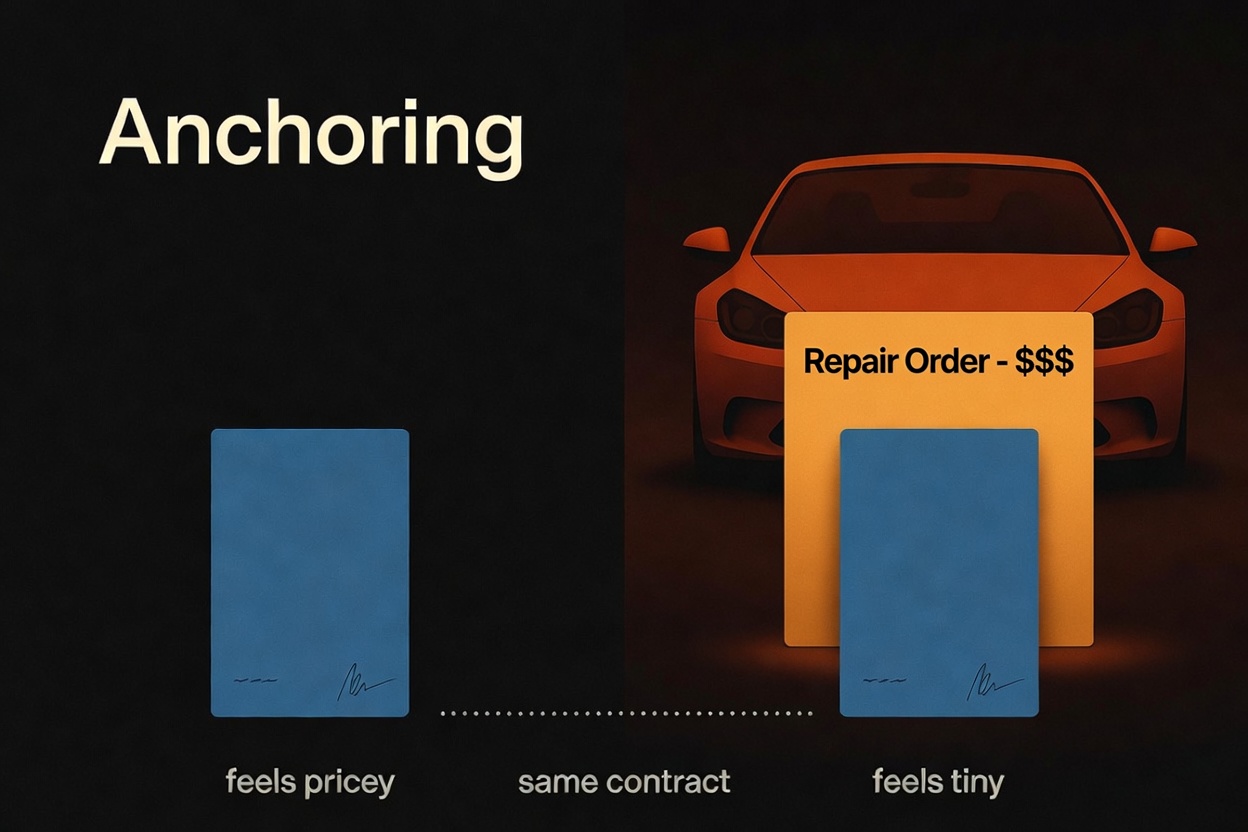
Anchoring
The human mind cannot judge a number in a vacuum. It grabs the first number in the room, any number at all, and measures everything else against it. Psychologists have shown this works even when the anchor is obviously meaningless: in the famous experiment, people spun a rigged wheel of fortune, then guessed how many African countries are in the UN. People who spun a 65 guessed nearly twice as high as people who spun a 10. A carnival wheel moved their judgment, and nobody felt it happen.
Now look at your office. Your customer just spent two hours agreeing to a five-figure vehicle. That number is the biggest anchor of their month, maybe their year, and it's already hanging in the air when they sit down at your desk. A vehicle service contract standing next to that number is a rounding error. The same contract standing alone, quoted cold over the phone six months later, sounds enormous. Nothing about the contract changed. Only its neighbors did.
On the floor
- Present the full menu first, every deal, every customer. The complete picture is the honest anchor, and everything discussed after it feels proportionate rather than piled on.
- Talk about protection in the context of the vehicle investment they just made, not as a standalone number floating in space.
- When a customer flinches at a price, they're usually comparing it to the wrong anchor: yesterday's phone bill, not the cost of the transmission it covers. Gently give them the right comparison.
- Watch it work on you, too: the lender's first counter anchors your whole negotiation. Name it in your head before you respond.
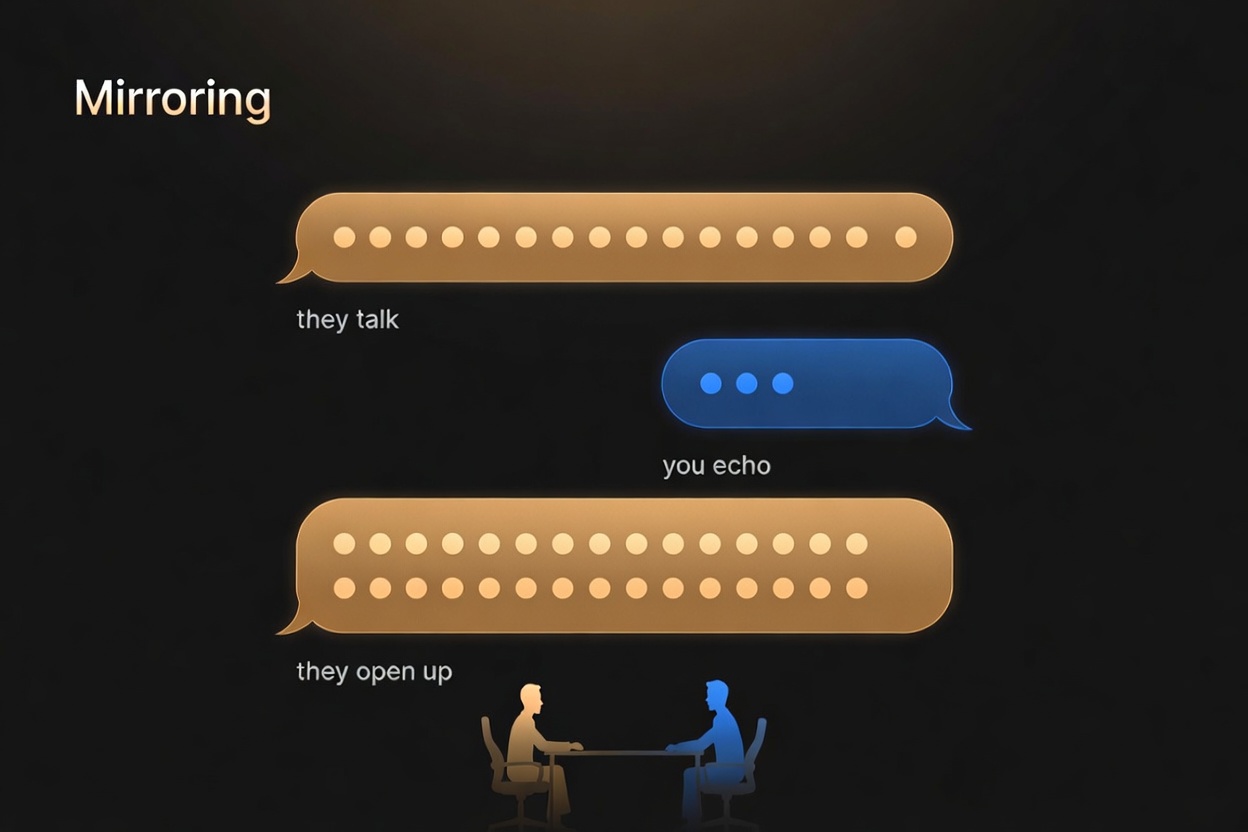
Mirroring
A mirror is the simplest move in negotiation and the hardest one for salespeople to trust: repeat the last one to three words the customer said, with a slight upward tone, and then stop talking. That's the entire technique. It feels like doing nothing. It is actually an invitation. The brain hears its own words come back and instinctively expands on them. FBI hostage negotiators used mirrors to keep armed men on the phone for hours; the negotiator sometimes said almost nothing else.
The science behind it shows up in ordinary places. In a well-known Dutch study, servers who repeated customers' orders back word for word, instead of just saying "got it," earned dramatically bigger tips. People don't just like being heard. They like hearing themselves, and they reward whoever holds up the mirror.
On the floor
- Mirror the emotional words, not the logistics. "The payment's just too high?" opens a door; "Four hundred and twelve dollars?" starts a math fight.
- Use it when a customer goes quiet or curt. The mirror restarts talkers better than any question.
- After the mirror, count four seconds of silence in your head. The silence is the tool; the mirror just aims it.
- One per beat. Chain three mirrors in a row and you sound like a parrot with a clipboard.
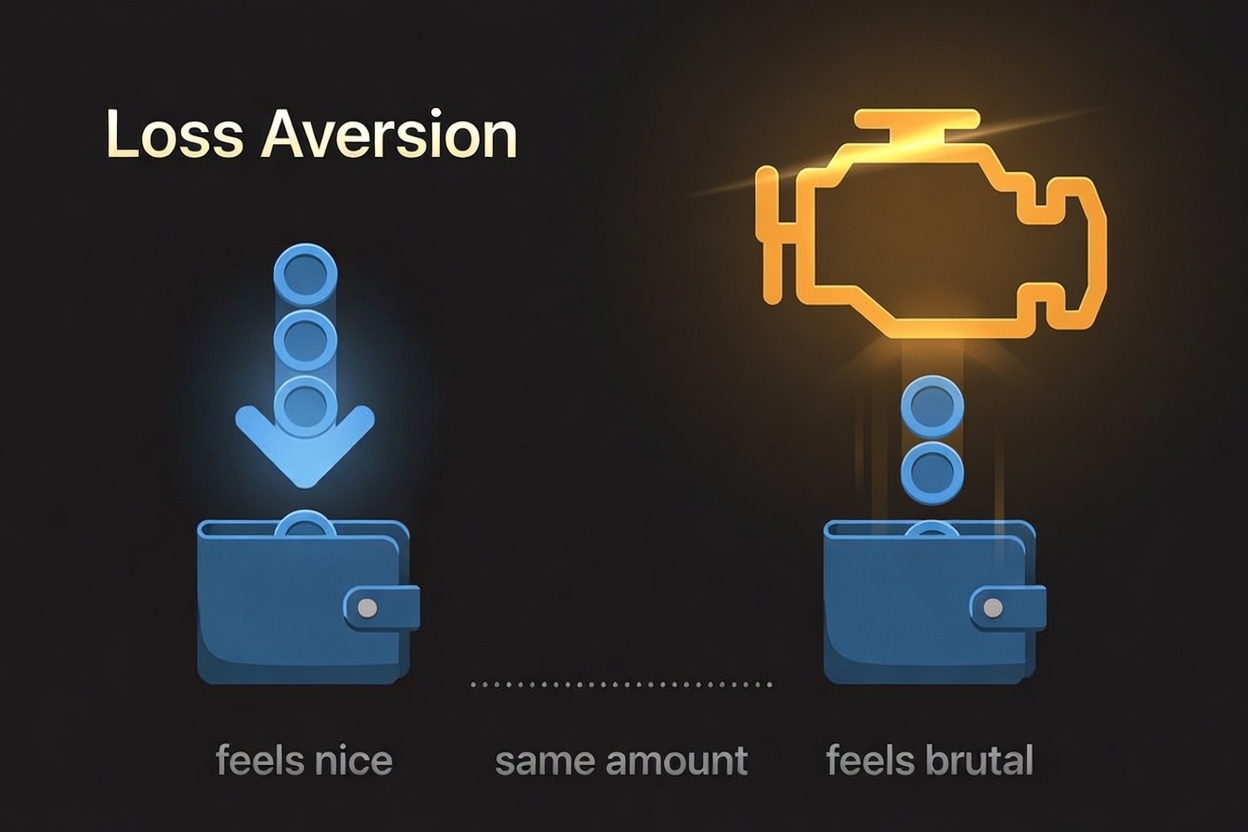
Loss Aversion
Offer someone a coin flip: heads they win $150, tails they lose $100. Mathematically it's free money. Most people refuse, and keep refusing until the win climbs to about double the loss. That ratio, roughly two to one, is one of the most replicated findings in behavioral economics: losses simply weigh more than gains of the same size. It's why the entire insurance industry exists, why investors hold losing stocks too long, and why "you'll save $30 a month" lands softer than "you're losing $30 a month."
Your customer runs on the same wiring. Present a service contract as a thing to gain, all features and benefits and coverage tiers, and you're pushing against the weak side of the scale. The strong side is what they already own and could lose: the emergency fund they just promised themselves they wouldn't touch, the monthly budget that finally balances, the six thousand dollars a hybrid battery costs the day the amber light comes on.
On the floor
- Frame protection around what the customer keeps: their savings, their payment stability, their plans. "This keeps your emergency fund your emergency fund."
- Name real, specific risks, meaning actual repair costs on their actual vehicle, never invented ones. Loss aversion is powerful, which is exactly why it must stay honest.
- When a customer declines, they're often loss-averse about the premium itself: the sure loss today versus the maybe loss someday. Acknowledge that trade openly; it builds more trust than pretending the premium isn't money.
- Trade-in conversations are loss aversion in the wild: customers overvalue the car they own because selling it feels like a loss. Budget extra empathy there.
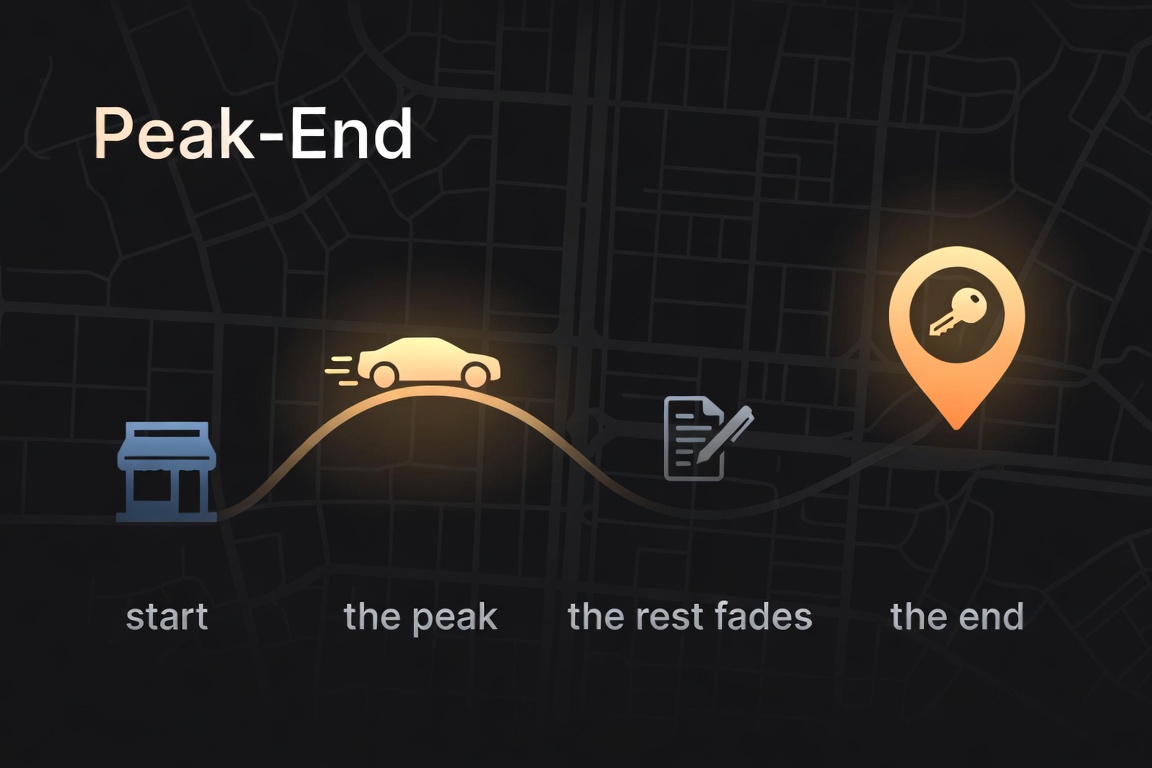
Peak-End
Memory is not a recording; it's an editor with a brutal red pen. When people look back on an experience, they don't average the whole thing. They keep two frames, the most intense moment (the peak) and the final moment (the end), and they judge everything by those. In the most famous demonstration, run by Daniel Kahneman, the psychologist whose research on decision-making won a Nobel Prize, patients who had a longer, gentler ending to an uncomfortable medical procedure remembered the entire procedure as better, even though they experienced strictly more discomfort overall. The extra minutes improved the ending, and the ending rewrote the memory.
Map that onto a car deal. The peak is usually the test drive: top of the world, new-car smell, green lights all the way. Then comes the long fade: the waiting, the numbers, the paperwork. And here's the uncomfortable truth for our side of the business: the F&I office is the part memory deletes, unless it becomes either a peak or a bad ending. A rushed, pressured final thirty minutes doesn't just feel bad in the moment; it retroactively poisons the whole day, the survey, and the referral. The customer doesn't remember buying a car. They remember how it ended.
On the floor
- Engineer a peak inside your office, one genuine wow: a payment that came in under their guess, a feature demo on their actual VIN, a moment where you visibly fought for them.
- Protect the end at all costs. The last five minutes belong to the customer and the car: keys, congratulations, a photo. Never the last signature.
- If something went wrong mid-deal, all is not lost: memory forgives a rough middle when the ending is warm. Fix the finish.
- Follow-up calls land on the memory, not the deal. Reference the peak ("How's she driving on that highway stretch you tested?") and you reactivate the best frame they kept.
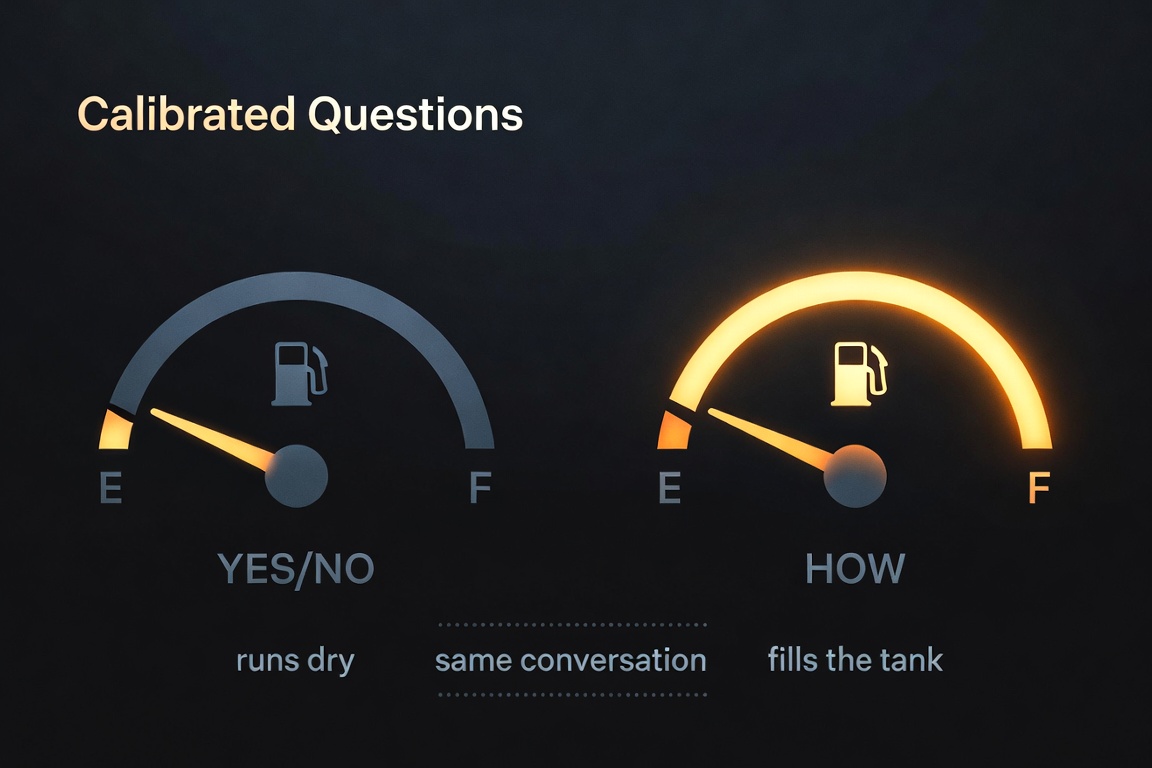
Calibrated Questions
Every question you ask has a fuel capacity. "Do you want to look at coverage options?" holds exactly one word of fuel, and the word is usually "no." Once it's spent, the conversation is coasting on fumes and you're the one pushing. A calibrated question, one that starts with "how" or "what," can't be answered in one word. It hands the customer the steering wheel while you choose the road: to answer it, they have to open up, reveal priorities, and start solving the problem with you instead of defending against you.
Chris Voss, the FBI's former lead international hostage negotiator whose job was getting concessions from people holding guns, used one calibrated question so often it became a signature: "How am I supposed to do that?" It refuses without saying no, and it makes the other side look at your constraints. The showroom translation works the same way. When a customer demands a number you can't reach, "How did you land on that figure?" does more work than any rebuttal. It either surfaces a real constraint you can solve, or it lets them hear their own number wobble out loud.
On the floor
- Swap "Do you keep your cars a long time?" for "How long do you usually keep your vehicles?" Same subject, ten times the fuel.
- Open the interview with "What matters most to you about how this vehicle holds up?" Their answer is your entire presentation, in their words.
- Meet resistance with "how": "How would you want to handle a major repair after the factory coverage runs out?" You're not arguing; you're handing them the problem to hold.
- Beware fake calibrated questions. "How great would it feel to be protected?" is a pitch wearing a question costume. Customers smell it instantly. Ask because you want the answer.
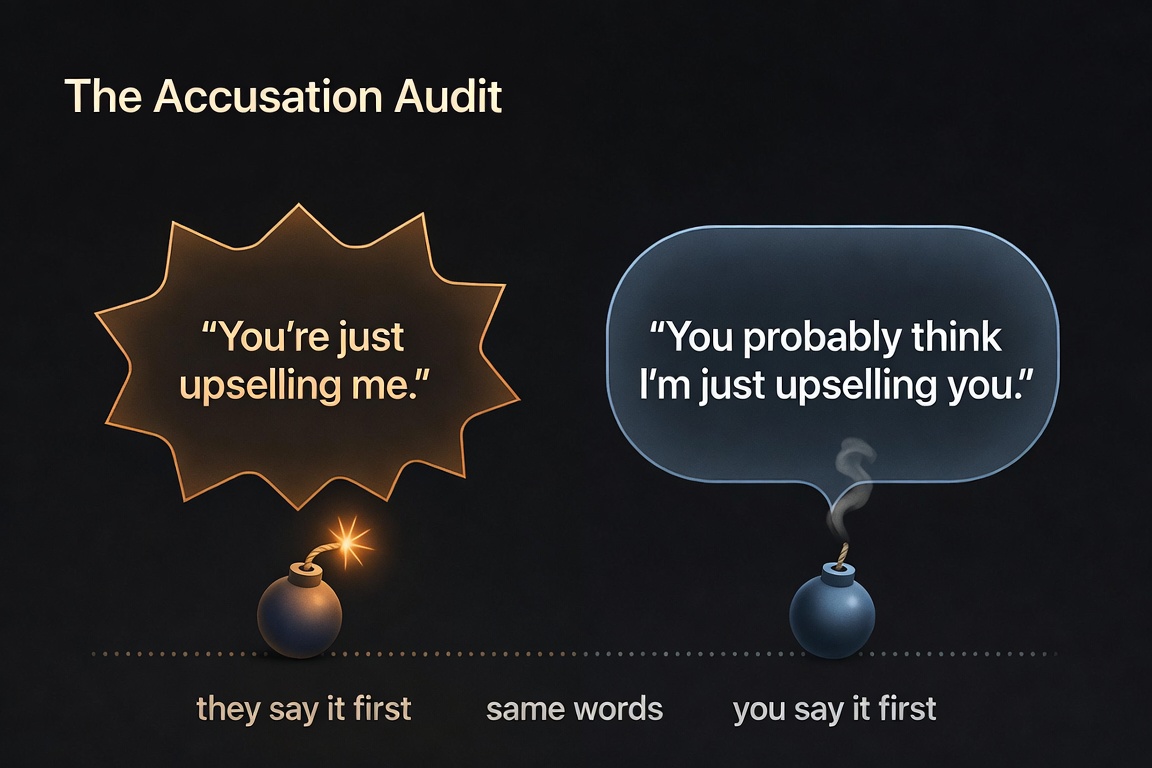
The Accusation Audit
Every customer walks into your office carrying a list of accusations they've already drafted: he's going to push add-ons, this is where they get you, everything in here is pure profit. Those charges sit under the conversation like pressure in a sealed tank, and they leak into every "no" you hear, even the ones that sound like they're about price. The accusation audit is the counterintuitive fix: you say their accusations first, out loud, before they can. Named by you, calmly, the charge has nowhere to detonate. What was going to be their ambush becomes your honesty.
Chris Voss, the FBI hostage negotiator who built this technique, opened one high-stakes negotiation by listing every terrible thing the other side must be thinking about him, before making any request at all. By the end of the list, the tension in the room had dropped, because there was nothing left to accuse him of. He'd audited himself. The customer's version of that list is shorter and you already know every line on it, because you've heard it a thousand Fridays in a row.
On the floor
- Open with the audit before the menu: "You're probably expecting me to pile on a bunch of extras you didn't ask for." The nod you get back is the pressure leaving the tank.
- Audit the internet: "You may have read that you should never buy anything in this office." Naming the blog post beats pretending it doesn't exist.
- Use it on the deal's real weak spot. If the payment came in high, say so first ("This payment is more than you wanted; let's talk about that") before they say it as an accusation.
- Keep it clean: audit, brief pause, move forward. Don't grovel and don't rebut your own audit. The power is in how unbothered you are saying it.
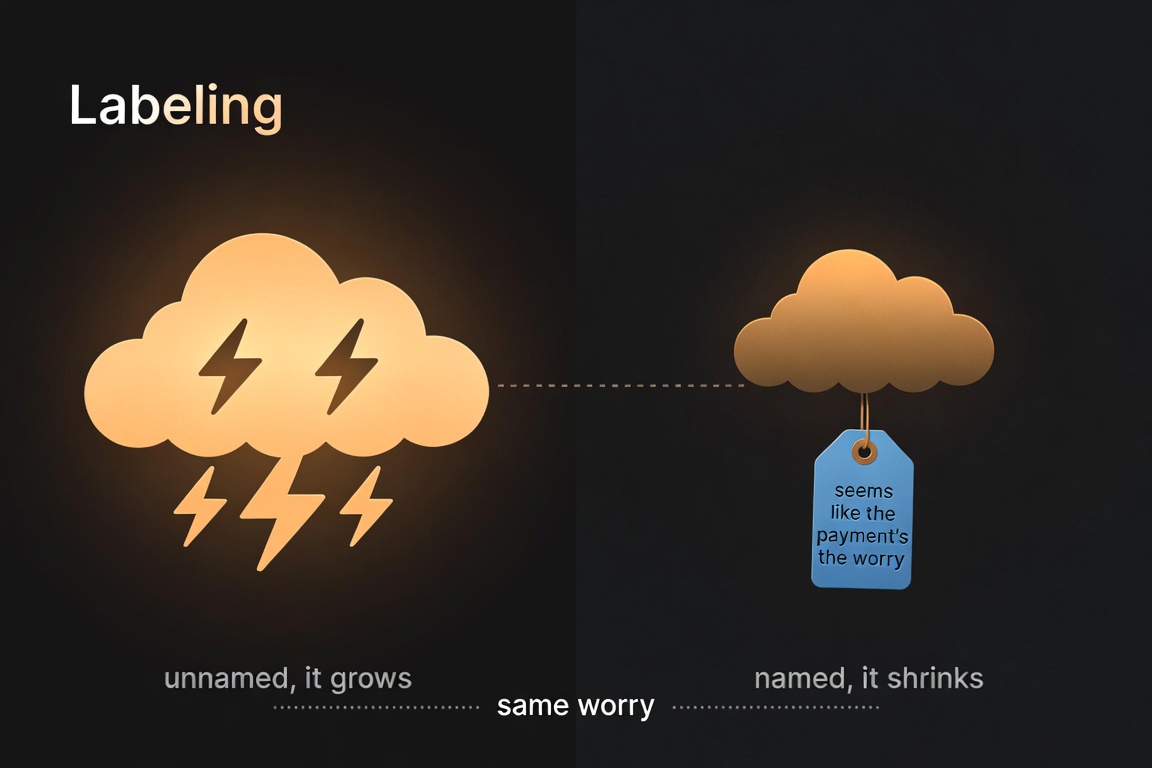
Labeling
When a feeling has no name, it runs the room. Neuroscientists have watched this happen in brain scanners: show someone a distressing image and the amygdala, the brain's alarm system, lights up. Ask them to put the feeling into words, and the alarm measurably quiets while the reasoning regions come online. Psychologists call it affect labeling. Parents of toddlers call it "naming the monster." Either way, the mechanism is the same one you need at your desk: an emotion that gets named gets smaller.
The tool is a short observation that starts with "It seems like…," "It sounds like…," or "It looks like…" Never "I understand," which claims credit for empathy you haven't demonstrated, and never "You're upset," which is an accusation wearing concern's jacket. "Seems like" is deniable and gentle: if you've read them right, they feel seen and the storm shrinks; if you've read them wrong, they correct you, and now you know something true either way. You cannot lose the exchange.
On the floor
- Label the hesitation you can see: "Seems like the payment's the worry" beats twenty minutes of feature review aimed at the wrong fear.
- Label positives too: "Sounds like this truck is a long-term keeper for you." A named intention to keep the vehicle is your best setup for a protection conversation.
- After a label, stop talking. Same rule as the mirror: the silence after is where the work happens.
- Pair it with the audit: label what they feel ("seems like you've been burned before"), audit what they suspect ("and you probably expect this office to do it again"). Storm named, pressure released, real conversation begins.
Seen the wall. Now work the floor.
Every piece in this room is a move you can practice against a live AI customer. No account, no sign-up.
Start training Or start with the two systems